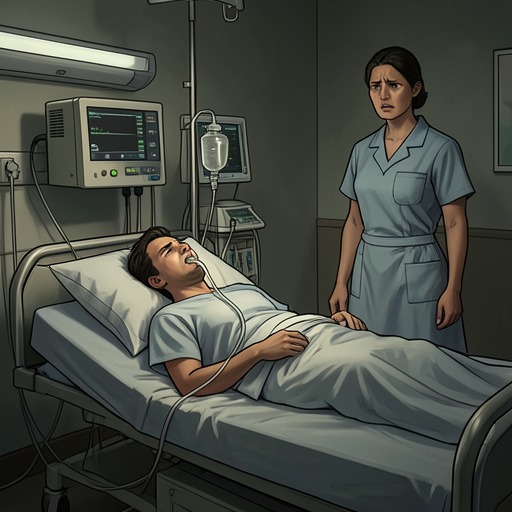
Conscious paralysis with mechanical ventilation
Impure BloodConscious paralysis with mechanical ventilation is a state in which a patient remains mentally alert while unable to move or speak, dependent on a ventilator and on other people to interpret limited signals. The novel presents it not as an absence of thought but as a painful mismatch between a vivid inner life and a body that can answer only through blinking. In an intensive-care room, the patient notices, remembers, judges, and wants; the people around him can still mistake silence for passivity, or mistake an ambiguous signal for consent.
Identity and Conditions
The patient is connected to a ventilator and heart monitor. He understands what is said around him, though he cannot answer aloud, and blinking is his available means of communication: one blink for yes, two for no. He recognizes the people caring for him and distinguishes among them, forming strong preferences even as his dependence makes him vulnerable to their decisions.
The room’s climate-control display gives him a point of focus. Its two screens show the intended and actual temperatures, both at 21.2 degrees. At first the matching figures reassure him; after sleeping and waking, he begins to wonder whether they are accurate or merely stuck. The display becomes a measure of how little he can verify for himself: reassurance, like communication, depends on trusting equipment and other people.
Awareness and Communication
His consciousness is evident in the detail of his attention. He follows the sounds of the ventilator and monitor, notices a caregiver’s hand near his forehead and endotracheal tube, and understands a quiet discussion about whether the tube’s flange could be loosened because it is making his mouth sore. The decision is made around him, with one caregiver insisting that it must remain secure and suggesting he will not feel the discomfort. The scene exposes the distance between being medically tended and being included in decisions about one’s own body.
He also listens to the staff’s ordinary conversations. When a new red-haired caregiver talks about her preferences, boyfriend, and private anecdotes, he silently registers the details and resents the assumption that he cannot understand. His attention is not limited to clinical matters: he can interpret tone and behavior, assess people, and imagine what he might say if speech were possible. The body’s inability to respond does not diminish the acuity of his awareness; instead, it makes his unexpressed judgments particularly stark.
Care, Trust, and Misreading
A caregiver he favors greets him affectionately and touches his forehead, while another adjusts the room’s equipment and charts. Their actions combine care with institutional routine. The patient’s view of the staff is not uniform: he is wary of being addressed as though he were a child and doubts whether most of them care, yet makes an exception for the caregiver he trusts. Dependence therefore does not produce simple gratitude or rejection; it sharpens his attention to how people treat him when they assume he cannot answer.
The clearest communication failure concerns a television. A caregiver tells him that the Tour de France begins the next day and that a set will be placed where he can watch. He wants it intensely, because cycling is something he loves and because its movement and color offer an absorbing focus. Trying to convey his enthusiasm, he blinks repeatedly. The caregiver reads that signal as refusal and withdraws the offer. He immediately understands that a single blink for yes and two for no would have been clearer, but his excitement has defeated the small code on which his agency depends.
The loss matters beyond entertainment. He experiences the promised broadcast as a connection to something familiar and sustaining, and its withdrawal as the consequence of being unable to make his intention legible. When the caregiver who understood him moves to another department, he fears losing the one person who cared. Later, a large screen is brought into the room; the changing images make him realize that the television has arrived after all. His anticipation is finally met, though the delay has already shown how fragile access to a desired thing can be when another person controls both the equipment and the interpretation of his signals.
Dependence and Personhood
The patient’s reflections on cycling give his condition a measure without making the two experiences equivalent. He compares the prospect of remaining attached to a ventilator with climbing Mont Ventoux into a headwind, noting that both can feel like being a living corpse, but that the pain of the climb is temporary. What he identifies as the deeper threat is helplessness: the sense that having things done for him can feel indistinguishable from having things done to him, and that others might decide he no longer has a useful life.
That fear is rooted in dependence, not in any demonstrated loss of understanding. His thoughts about the temperature, his wish to watch the race, his judgments of caregivers, and his careful listening all establish a continuing point of view. The medical setting offers no easy way for that viewpoint to become audible. Blinking can communicate, but only if others ask, wait, and interpret it accurately; routine care can protect him while also reducing him to a body being managed.
Narrative Significance
The state makes communication ethics concrete through small, consequential exchanges rather than abstract declarations. A temperature readout can reassure and then provoke suspicion; a repeated blink can express intense desire yet be taken for its opposite; a chart and ventilator can coexist with a patient who is closely observing everyone in the room. These details keep clinical dependence in view without treating the patient’s consciousness as uncertain simply because he cannot speak.
The promised and eventually present television also links his confined life to the Tour de France, a spectacle defined by movement and forward travel. For him, the race is not merely something to pass the time: it is a beloved focus, and the road winding onward offers a contrast to a life whose immediate choices are made by others. The contrast clarifies what the condition puts at stake—access to the world, the ability to express preference, and recognition as a person who remains present within a body that cannot answer in the usual way.